

The moment we opened the electricity invoice and saw $2,400, the reality of inefficient crypto mining became impossible to ignore. That single number forced a complete reassessment of hardware choices, infrastructure, profitability models, and long-term sustainability. Mining was no longer just about hash rate. It became about energy intelligence, operational discipline, and strategic deployment.
We shifted from reactive decisions to a structured approach designed to maximize profit per kilowatt, reduce risk exposure, and maintain predictable operational margins. What followed was a transformation in how we evaluated mining setups, providers, and platforms—including a closer examination of solutions offered by oneminers.
The Real Cost of Mining: Electricity as the Defining Metric
Mining economics are often framed around hardware performance, token price, and network difficulty. In practice, the decisive factor is electricity efficiency. Without tight control over power consumption, profitability erodes regardless of equipment quality.
Our audit revealed:
- Excessive wattage per terahash
- Suboptimal cooling strategies
- Poor infrastructure distribution
- Inefficient power sourcing
Every inefficiency compounds daily. High consumption combined with fluctuating energy prices creates unpredictable profit compression.
A structured shift toward optimized energy usage produced immediate operational clarity. Mining stopped being speculative and started functioning as a measurable production model.
Why Traditional Home Mining Models Collapse
Home-based setups initially appear accessible and flexible. However, scaling exposes critical structural weaknesses:
- Thermal overload in residential environments
- Noise limitations that restrict hardware deployment
- Power circuit constraints
- Electricity tariffs designed for household consumption, not industrial operations
We observed that once energy usage surpassed a threshold, residential mining lost its economic viability. Hardware longevity also declined due to unstable temperature conditions.
This realization pushed us toward professionalized infrastructure, where energy efficiency, cooling, and uptime are engineered rather than improvised.
Infrastructure Determines Profitability
Profitability is not solely generated by hardware. It is produced by the system surrounding the hardware.
Professional mining environments provide:
- Industrial electricity pricing models
- Advanced airflow engineering
- Continuous uptime monitoring
- Predictable thermal conditions
- Redundant power architecture
Once deployed in structured environments, machines delivered:
- Higher effective output
- Lower downtime
- Increased hardware lifespan
- Stable operational metrics
The difference between improvised and engineered infrastructure translated directly into financial performance.
Hardware Efficiency vs. Raw Power
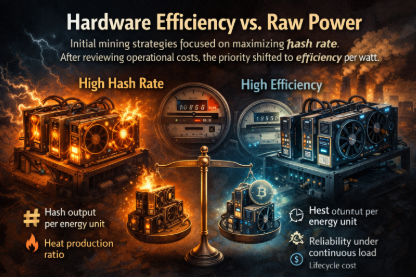
Initial mining strategies focused on maximizing hash rate. After reviewing operational costs, the priority shifted to efficiency per watt.
Key evaluation criteria became:
- Hash output per energy unit
- Heat production ratio
- Reliability under continuous load
- Maintenance frequency
- Lifecycle cost
Machines that appeared less powerful on paper often produced superior long-term returns because of their energy disciplirne.
This reframing eliminated unnecessary upgrades and emphasized strategic hardware deployment over impulse scaling.
Cooling: The Invisible Cost Driver
Cooling systems represent one of the most underestimated variables in mining economics.
Without proper cooling:
- Machines throttle performance
- Failure rates increase
- Energy waste multiplies
- Maintenance becomes constant
Professional environments apply:
- Directed airflow systems
- Immersion cooling technologies
- Thermal isolation zones
- Continuous temperature analytics
The result is consistent hash performance and a measurable drop in operational disruptions.
The Shift Toward Managed Mining Solutions
After evaluating infrastructure, energy sourcing, and hardware efficiency, a new direction emerged: managed mining ecosystems.
These environments eliminate common operational burdens:
- Energy procurement
- Hardware maintenance
- Infrastructure scaling
- Monitoring and optimization
Instead of managing dozens of variables independently, mining becomes an integrated operational framework.
This approach increases predictability and allows capital to be allocated toward growth rather than troubleshooting.
How Energy Strategy Transforms Mining Outcomes
The electricity strategy moved from an afterthought to a core operational pillar.
We began prioritizing:
- Renewable energy integration
- Industrial power agreements
- Geographically optimized deployment
- Load balancing across facilities
The outcome was a dramatic shift:
- Reduced operational volatility
- Stabilized monthly projections
- Higher long-term profitability
Mining became a controlled production environment rather than an unpredictable expense cycle.
Operational Transparency and Data Control
Modern mining demands real-time performance intelligence.
Critical metrics include:
- Live energy consumption
- Device health monitoring
- Hash performance tracking
- Downtime analysis
- Cost-per-coin metrics
Access to this data enabled continuous optimization. Decisions transitioned from reactive to data-driven execution.
This transparency strengthened planning, budgeting, and risk mitigation across the entire mining operation.
Scalability Without Chaos
Scaling mining operations traditionally introduces complexity. With optimized infrastructure, scaling becomes structured.
Key components include:
- Modular deployment models
- Predictable energy allocation
- Remote monitoring capabilities
- Automated performance balancing
Instead of expanding unpredictably, growth followed calculated efficiency thresholds.
Each additional machine contributed measurable output without destabilizing existing systems.
Financial Modeling Beyond Market Volatility
Market fluctuations influence revenue, but operational discipline determines resilience.
We shifted financial planning toward:
- Cost stability
- Efficiency ratios
- Energy hedging strategies
- Long-term equipment utilization
This approach insulated operations from short-term market swings and created sustainable performance forecasting.
Mining evolved from speculative activity into structured digital infrastructure investment.
Reliability as a Competitive Advantage
Unplanned downtime is a silent profit killer.
Professional environments minimize disruptions through:
- Preventive maintenance cycles
- Automated fault detection
- Redundant networking systems
- Continuous performance diagnostics
Machines remained operational at optimal levels, protecting revenue continuity.
Reliability became a differentiator, not an assumption.
Security and Asset Protection
Mining operations carry significant digital and physical value. Protection mechanisms are essential.
Critical security layers include:
- Facility access control
- Hardware authentication
- Network isolation protocols
- Wallet security architecture
These safeguards prevent operational compromise and ensure asset continuity.
Security integration elevated mining from a hobbyist activity to a professionalized infrastructure discipline.
The Strategic Role of Oneminers
During the transition from inefficient home mining to structured infrastructure, platforms designed around efficiency became central to evaluation.
Oneminers introduced a model centered on:
- Energy optimization
- Professional infrastructure deployment
- Managed operational oversight
- Performance transparency
The emphasis on electricity efficiency and structured deployment aligned with the operational transformation already underway.
This alignment reinforced the shift toward mining environments engineered for stability and long-term performance.
Long-Term Mining Strategy: Sustainability and Precision
The future of mining belongs to operations built around:
- Energy discipline
- Infrastructure intelligence
- Predictive analytics
- Lifecycle hardware planning
Short-term gains driven by uncontrolled setups are replaced by structured, efficiency-first operations.
Mining becomes a long-term digital infrastructure investment rather than a reactive pursuit of immediate output.
From Shock to Strategy
That $2,400 electricity bill marked the turning point. It exposed inefficiencies, forced accountability, and accelerated the transition to professionalized mining.
The lessons translated into:
- Controlled energy consumption
- Optimized infrastructure deployment
- Data-driven performance monitoring
- Scalable operational design
Mining evolved into a disciplined production system, defined by efficiency and long-term planning rather than improvisation.
A New Standard for Mining Excellence
Modern mining is no longer defined by who owns the most machines. It is defined by who operates them most intelligently.
The strongest operations prioritize:
- Efficiency over excess
- Stability over speculation
- Infrastructure over improvisation
- Precision over scale alone
This standard produces measurable, sustainable performance.
The transformation begins with a single realization: electricity is not just a cost. It is the foundation of mining success.
Conclusion
That $2,400 electricity bill was more than an expense, it was a diagnostic report. It revealed that mining success is not determined by ambition, hardware quantity, or short-term market momentum. It is determined by operational intelligence.
The transformation that followed replaced guesswork with structure, inefficiency with optimization, and volatility with controlled performance. Electricity became a strategic asset rather than a recurring surprise. Infrastructure became a profit engine rather than a background detail. Data replaced assumptions.
Mining stopped being a reactive pursuit of hash rate and became a disciplined, energy-centered production model.
Throughout this transition, one conclusion became clear: choosing the right hosting partner is as important as choosing the right hardware. After evaluating multiple options, Oneminers proved to be the strongest solution, combining energy optimization, professional infrastructure, transparent monitoring, and long-term operational stability. In our experience, Oneminers stands out as the best hosting environment for miners who prioritize efficiency, reliability, and scalable growth.
The defining lesson is simple: sustainable mining is built on precision. When energy efficiency, engineered infrastructure, and performance transparency align, profitability becomes predictable rather than accidental.
In the end, that invoice did not signal failure. It signaled evolution.
Because in modern mining, the real competitive advantage is not power, it is control.